
SHARE
At dawn above treeline, whether you’re in the Cascades, the the Sierra, the Andes, or the Himalayas, the wind moves steadily over rock and ice and finds its way into every weak seam in your layers. It doesn’t matter how experienced you are or how well you’ve prepared—these moments of exposure can mirror what successful men feel during a midlife crisis. Up there, you feel exposed in a simple, physical way.
Over the years, I’ve watched many men change in that environment. Not dramatically or for show, but quietly and honestly.
They arrive competent, capable, and self-controlled. They leave more aware of themselves—often for the first time in years.
The Men Who “Should” Be Fine
Most of the men I work with look successful by conventional standards. They’ve built careers, supported families, led teams, and done what was expected of them. From the outside, their lives appear solid and respectable.
From the inside, many feel restless, flat, or disconnected.
They rarely describe this as a crisis. More often, they talk about being tired, irritable, unmotivated, or strangely numb. They say they “should” feel grateful. That word comes up again and again. It’s usually a sign that someone is trying to override their own experience.
In psychology, this is often linked to role saturation—when identity becomes dominated by responsibility. Provider. Leader. Fixer. Performer. Over time, emotional range narrows. Curiosity fades. Life becomes functional but thin.
1:1 Men’s Coaching – Learn More
The Successful Men Midlife Crisis Nobody Talks About
Modern men are rewarded for control. Control your emotions. Control your image. Control your schedule. Control your body. That approach works for a long time.
Then, often in midlife, it starts to fail.
Nothing obvious breaks. Careers may still be strong. Families may still be intact. Health may be decent. But something feels wrong. Motivation drops. Patience thins. A sense of meaning erodes.
What many of these men are experiencing is not a dramatic breakdown, but a slow, internal successful men midlife crisis that unfolds behind professional competence and social stability.
Carl Jung referred to this as “the unlived life”—the parts of the self that were postponed or sacrificed in order to be practical and responsible. Those parts don’t disappear. They wait.
Eventually, they ask to be acknowledged.
Why Hard Places Still Matter
I didn’t come to this work through theory first. It came through years in the mountains—storms, long approaches, failed objectives, and cold nights when comfort wasn’t an option.
In those places, credentials don’t matter. Your job title doesn’t help you manage fear. Your income doesn’t improve your judgment. Your reputation doesn’t keep you warm.
What matters is attention, emotional regulation, communication, and humility.
Adventure environments remove many of the buffers men rely on in daily life. There’s no constant distraction. No curated identity. No easy escape. You meet yourself more directly.
That confrontation is often uncomfortable. It’s also productive.
Learn more: Men’s Adventures & Retreats
The Conversations That Happen on Day Three
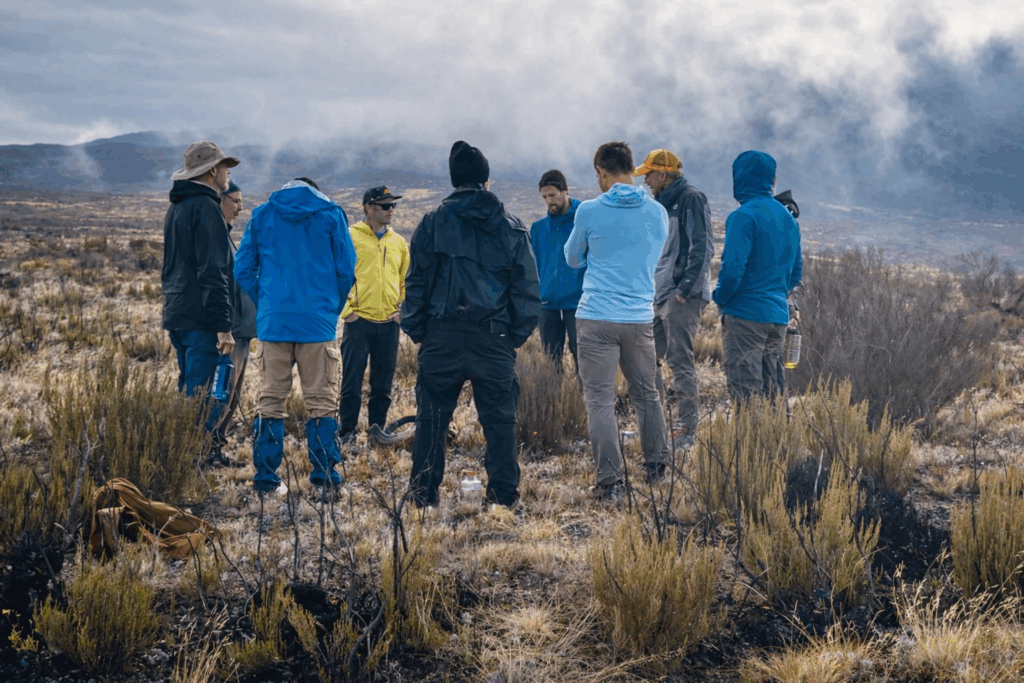
On longer trips, something predictable tends to happen around the third day.
People are tired. The novelty has worn off. Bodies are sore. Phones are useless. Social performances collapse.
Someone finally admits they’re unhappy. Or uncertain. Or afraid they’ve built a life that doesn’t fit anymore.
Once one man speaks honestly, others usually follow.
These are not dramatic confessions. They’re quiet, thoughtful conversations between men who rarely have space for this kind of reflection. There’s no formal agenda. Just time, shared effort, and trust.
Reconnection, Not Escape
There’s a common assumption that men seek adventure to escape their lives. In practice, most are doing the opposite.
They’re trying to reconnect.
With their bodies.
With their instincts.
With their values.
With parts of themselves that went dormant.
Research supports this. Time in demanding natural environments improves emotional regulation, lowers stress, restores attention, and increases a sense of meaning. Difficult, real places interrupt autopilot.
They create perspective.
What Changes Afterward
Men don’t return from this work “fixed.” That’s neither realistic nor healthy.
They return clearer.
They recognize patterns they’ve been avoiding. They see where they’ve been numbing themselves, overworking, withdrawing, or staying silent. That clarity leads, over time, to different choices—career changes, relationship repairs, creative risks, firmer boundaries, deeper mentoring.
Not because someone told them what to do.
Because they can finally hear themselves.
Beyond Peaks and Performance
Summits are enjoyable. They are not the point.
The real work is learning how to stand inside your own life with honesty and resilience. Most men don’t need more productivity systems or motivational language.
They need space.
Challenge.
Community.
Silence.
Places where they’re allowed to be unfinished.
That is what these environments provide.
If This Feels Familiar
If parts of this sound uncomfortably close to home, that doesn’t mean something is wrong with you. It usually means you’re paying attention.
Restlessness is often a signal, not a failure.
The question is whether you’re willing to listen.
Adventure, at its best, is not about escape.
It’s about remembering who you are beneath the roles you’ve learned to perform.
If this feels familiar, let’s have a conversation.